Food Adventure No. 001 · Recipes · Thailand 🇹🇭
Chicken Pad Thai
Turn noodles, chicken and a few surprising flavours into one of Thailand's most famous dishes — and discover a whole country while you cook.
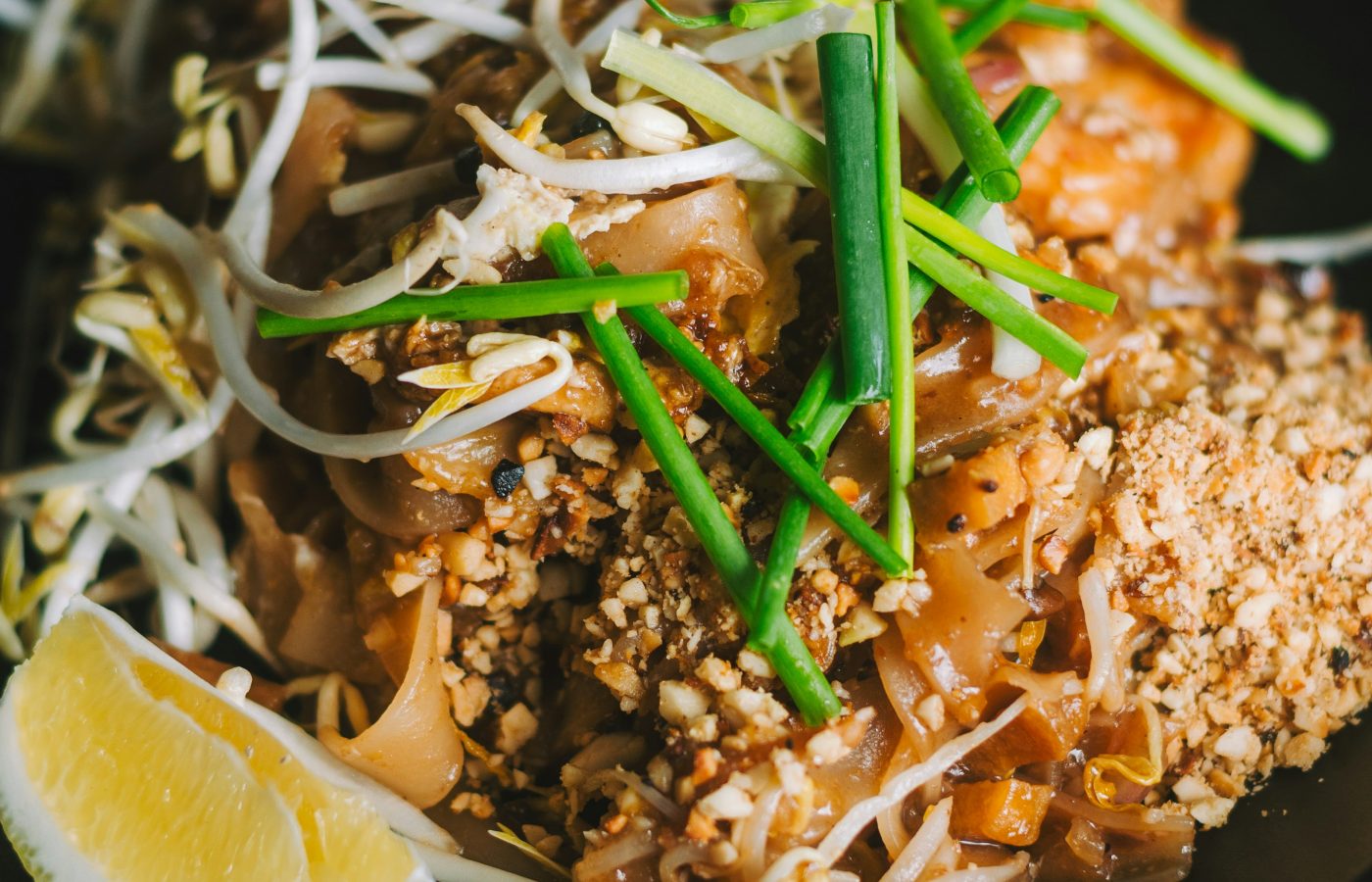
Today we’re travelling to Thailand to make one of its most famous dishes. Along the way we’ll balance four flavours, meet a fruit called tamarind, and do a little chemistry with an egg. Ready? Let’s cook.

🌍 Geography Stop · Bamboo & Twig
Where are we going?
Thailand is in Southeast Asia, with coastlines on the Andaman Sea and the Gulf of Thailand, and borders with Myanmar, Laos, Cambodia and Malaysia. Find it on a map before we start.
🗣️ Language Stop · Bamboo & Twig
What does “pad” mean?
In Thai, ผัด (phat / pad) means something like “stir-fried.” So whenever you see pad in a dish’s name, you can already guess how it was cooked.
🧺 Pack your backpack — for the noodles
- 250 g flat rice noodles
- 300 g boneless chicken breast or thigh
- 2 eggs
- 2 cloves garlic · 2 spring onions · 100 g bean sprouts · 1 carrot
- 2 tbsp neutral cooking oil
For our flavour sauce
- 2 tbsp tamarind paste · 2 tbsp fish sauce · 2 tbsp brown sugar · 1 tbsp lime juice
For the finish
- 40 g roasted peanuts · 1 lime · extra bean sprouts · coriander (optional)
⚠️ Allergy alert: contains egg, fish and peanuts. Always check packaged ingredients too.
The adventure begins
-
Wake up the noodles
Cover the rice noodles with warm water and leave for 15–20 minutes, until flexible but not fully soft. They will finish cooking in the wok.
-
Build the sauce
Mix 2 tbsp tamarind + 2 tbsp fish sauce + 2 tbsp sugar + 1 tbsp lime. Taste a tiny amount. Too sour? A little sugar. Too sweet? A little lime.
-
Prepare your supplies
Slice the chicken thin, cut the carrot into matchsticks, slice the spring onions, chop the garlic, crush the peanuts.
-
Get things hot
Medium-high heat, 1 tbsp oil, cook the chicken through, then move it to a clean plate.
-
Egg transformation
Add the rest of the oil and the garlic, crack in the eggs, let them set, then scramble into chunky pieces.
-
Everything meets in the wok
Drain the noodles, add them with the chicken, pour over the sauce and toss for 2–4 minutes. Add carrot, spring onions and most of the bean sprouts; cook one more minute. Keep it all moving — that is the stir in stir-fry!
Kitchen Science · Nori
Why do the noodles need “waking up,” not cooking?
Rice noodles have no gluten — they are mostly rice starch. When starch meets water and heat it absorbs water and changes structure. That is gelatinisation. Soak them too long now and they will turn to mush in the wok.

🔢 Maths Mission · Sunny
The sauce ratio is 2 : 2 : 2 : 1
To make twice as much, how much of each? What about half? You have just used ratios in a real kitchen.
Kitchen Science · Nori
Why does the chicken turn brown?
When proteins and sugars on the surface get hot, hundreds of new flavour compounds form — the Maillard reaction. It is why browned chicken tastes different from boiled. And the egg? Heat unfolds its proteins and joins them together: protein denaturation. You just did chemistry with breakfast.

Food Safety · Kombu
Why we wash the board after raw chicken
Raw chicken can carry bacteria such as Campylobacter. Never use the same unwashed board or knife for cooked food afterwards — that is preventing cross-contamination. Cutting raw chicken should be supervised.
🕵️ Ingredient Detective · Kombu
What exactly is tamarind?
That fruity sourness is tamarind — sticky pulp from pods on the tree Tamarindus indica. Despite its name it probably began in tropical Africa, then travelled through trade to Asia, Latin America and the Caribbean.
🥢 Taste like a cook
Is it balanced?
Before serving, stop and taste. Do not ask “is it good?” — ask “is it balanced?” Make one small change, mix, and taste again.
🍋 Sour (tamarind & lime) · 🍬 Sweet (sugar) · 🧂 Salty (fish sauce) · 🌶️ Spicy (chilli, if you like).
Food History · Bamboo & Twig
Is Pad Thai ancient?
Surprisingly, no. It became strongly linked to Thailand in the 20th century, around the time of Prime Minister Plaek Phibunsongkhram. Food can become part of a country’s modern identity — so a bowl of noodles can teach us about history and politics too.
⭐ Adventure badges
🧾 Your expedition log
- My Pad Thai score: ___ / 10
- The strongest flavour was: ______________
- The new ingredient I tried was: ______________
- The coolest thing I learned was: ______________
🚀 Where could we travel next?
Japan for okonomiyaki, Vietnam for bánh mì, Mexico for tacos — one kitchen, a whole world to explore.