Kitchen Kit
The Slow Cooker
Put dinner in before lunch, turn a dial, disappear for the afternoon — and come back to tender meat and a kitchen that smells amazing. Is a slow cooker magic? Not quite: it's heat, water, time and some very useful kitchen science.
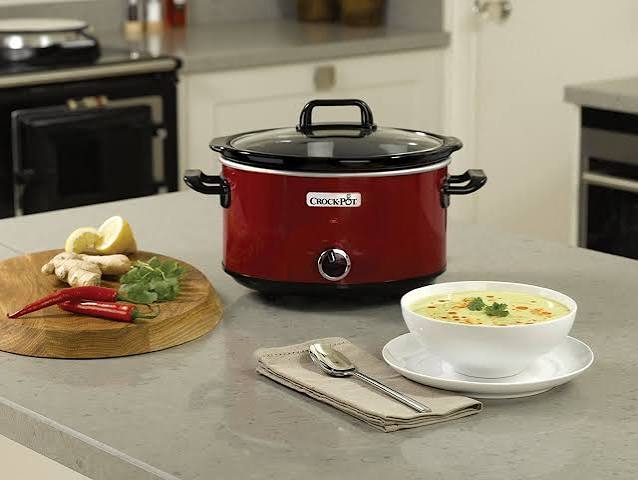
Put dinner in before lunch, turn a dial, disappear for the afternoon — and somehow come back to tender meat and a kitchen that smells amazing. Is a slow cooker magic? Not quite. It’s heat, water, time and some very useful kitchen science.
🔥 Gentle heat · ⏱ Lots of time · 💧 Trapped moisture · 🧪 Kitchen science
🔎 Kitchen Kit · Nori
What exactly is a slow cooker?
A slow cooker is an electrical cooking pot designed to cook food gently for several hours. Most have three main parts: 🥘 the cooking pot (where our food goes), 🔥 the heating unit (which produces heat around the pot), and 🪟 the lid (which traps heat and moisture inside). Put them together and you have a small cooking environment that can stay warm for hours without the fierce heat of a frying pan or oven — which is why we could start our carnitas in the morning and leave time do most of the work.
🧪 Kitchen Science · Nori
Slow doesn’t mean cold
A slow cooker still gets hot — it simply heats food much more gently than a frying pan. As the cooker warms, heat moves from the heating element into the pot and then into our food, until the liquid becomes hot enough to cook the ingredients thoroughly. The important word is temperature: cooking isn’t just about how long food sits somewhere — food needs to reach the right temperatures for the changes we want, and for safe cooking.
🔥 Science Stop · Nori
How does the heat reach our dinner?
Heat can travel in several ways, and inside our slow cooker we can spot two important ones. Conduction: heat passes through materials that are touching — the heated cooker warms the pot, and the hot pot warms the food touching it. Convection: as liquid becomes warmer it moves, so warmer and cooler parts circulate and help spread heat through the pot. So even while our carnitas look as though they’re doing absolutely nothing, energy is moving everywhere.
💧 Kitchen Science · Nori
Where does all that liquid come from?
Remember our carnitas recipe? We specifically said don’t fill the slow cooker with water. That’s because many ingredients already contain lots of water — meat, onions, and the oranges and lime we added. As everything heats, juices are released, and the lid helps stop moisture escaping into the kitchen. So after several hours we can end up with more visible cooking liquid than we started with.
☁️ Science Mission · Nori
Why is the lid wet?
Look through the glass lid while something cooks and you may see tiny drops of water collecting underneath. Water from our food evaporates into water vapour; when that vapour reaches the cooler lid, some changes back into liquid — that’s condensation — and the droplets fall back into the pot. You’ve made a tiny version of part of the water cycle in your kitchen: evaporation → condensation → water returns. No clouds required.
🚫 Nori’s Rule
Stop lifting the lid!
It’s incredibly tempting: something smells wonderful, you want to see what’s happening, so you lift the lid — whoosh — and some of the accumulated heat and water vapour escape. The cooker then has to work back towards its cooking conditions. An occasional check when necessary is fine, but repeatedly opening it just because you’re curious isn’t helpful. Fortunately, that’s exactly why many slow cookers have glass lids: you may spy on dinner without disturbing it.
🥩 Kitchen Science · Nori
Why is the slow cooker brilliant with tough meat?
Some harder-working muscles contain plenty of connective tissue, and one important protein in it is collagen. Cook those cuts too quickly and they can stay tough; give them enough time under gentle, moist conditions and collagen gradually breaks down into gelatin, and the meat becomes tender enough to pull apart. That’s why inexpensive cuts like pork shoulder can be fantastic slow-cooker ingredients — our carnitas demonstrated it beautifully.

🕵️ Ingredient Detective · Kombu
Does that mean expensive meat is always better?
No! Different cuts have different structures, amounts of fat and connective tissue, so they suit different cooking methods. A cut that’s wonderful cooked quickly in a hot pan isn’t automatically best for eight hours in a slow cooker — and a tougher, cheaper-looking cut can become delicious after long, gentle cooking. A good cook doesn’t ask “which ingredient costs more?” They ask “what cooking method suits this ingredient?”
🧪 Kitchen Mystery · Nori
Why didn’t our carnitas turn brown?
When we opened the slow cooker, our pork was beautifully tender — but not particularly crispy. The moist environment inside a slow cooker is excellent for tender cooking, but it isn’t good at producing the hot, dry surface conditions that give us browning. So we used a second tool: the grill. Slow cooker → tender. Hot grill → brown and crispy. Sometimes one cooking method can’t do every job — great cooks combine techniques.
🧠 Kitchen Science · Nori
Remember the Maillard reaction?
We met it in our Pad Thai and again in the carnitas. When the surface of food becomes hot enough, reactions involving amino acids and certain sugars create lots of new flavour and aroma compounds — part of why browned meat tastes so different from pale boiled meat. Our wet slow cooker isn’t designed for that surface browning, so after shredding the pork we gave it a quick blast of intense heat. Tender inside + browned edges = much more interesting carnitas.
⏱ Maths Mission · Sunny
Can you make dinner appear at exactly the right time?
Slow cookers turn meal planning into a maths problem. If dinner needs to be ready at 18:00 and the recipe needs 8 hours on LOW, when should we start? Now try these: dinner at 17:30 with 7 hours cooking; dinner at 19:15 with 8 hours; and cooking that begins at 10:45 and takes 7½ hours — what time will it finish? This is elapsed time, and suddenly maths controls dinner.
⚡ Kitchen Science · Nori
Where does the energy come from?
Our slow cooker uses electricity, and electrical energy is converted into thermal energy — heat. With an adult, look underneath your slow cooker or at its label. Can you find a number followed by W? That means watts — watts tell us the rate at which a device uses energy. A slow cooker may use much less electrical power at any moment than a large electric oven, though actual energy use depends on the appliance and how long each one runs. We’ll investigate kitchen energy properly another day.
🌡️ Food Safety · Kombu
Slow cooking still has safety rules
“Slow” doesn’t mean food can spend all day at any temperature — microorganisms grow well under some conditions, so food must be handled and cooked properly. A few rules: 🥩 keep meat refrigerated until you’re ready; 🧊 don’t improvise with frozen meat (use properly thawed pork and follow the instructions); 🥘 don’t massively overfill the pot, or it can’t heat properly; 📖 read your machine’s instructions, because slow cookers differ; and 🌡️ for meat dishes a food thermometer is a far better safety tool than guessing from colour. And never taste meat to find out whether it’s cooked.
🔢 Equipment Detective · Sunny
How big is your slow cooker?
Slow cookers come in different sizes — find the capacity of yours. It might say 3.5 litres, 5 litres or 6.5 litres. Now find a one-litre measuring jug: how many of those would theoretically fit inside? You’ve just connected a number printed on an appliance to a real physical volume.
🧪 Nori’s Experiment · Nori
Does opening the lid matter?
Next time you make a slow-cooker dish, resist opening the lid — observe through the glass instead, and write down what you see:
- 10:00 — ingredients look like: ______________
- 11:00 — I can see: ______________
- 12:00 — condensation is: ______________
- 14:00 — the liquid level looks: ______________
- 16:00 — the ingredients have changed by: ______________
You’re making observations over time — exactly what scientists do during an experiment.
👃 Sensory Science · Nori
How can we smell dinner if the lid is closed?
Even with the lid on, aromatic molecules can escape from the cooker and travel through the air until some reach the receptors inside your nose. That’s why you can walk into the house hours later and immediately know something good has happened — your nose has detected chemical information before you’ve even seen dinner.
🛠️ Kitchen Engineer · Nori
Could you design a better slow cooker?
Imagine you’re an engineer. What would you add — a temperature sensor? A timer? A screen showing time left? A probe that measures the food? A phone alert? An automatic switch to keep-warm mode? Draw your ultimate slow cooker, label every new feature, and explain what problem each one solves. Congratulations — you’ve moved from using technology to designing it.
🌮 Where we used the slow cooker
Our first slow-cooker expedition took us to Mexico for Slow-Cooker Orange Carnitas 🇲🇽. We used long, gentle cooking to transform pork shoulder into tender shredded meat, then deliberately switched cooking methods and used intense heat to make the edges crispy. One ingredient, two cooking environments, two completely different jobs.
⭐ Kitchen Kit badges
🧾 Your equipment log
- My slow cooker holds: ______ litres
- LOW takes approximately: ______________
- HIGH takes approximately: ______________
- Heat reaches the food by: ______________
- Water on the lid is caused by: ______________
- Collagen can become: ______________
- The coolest thing I learned was: ______________
- Something I’d like to cook in it next: ______________
🚀 Where could our slow cooker take us next?
Mexico was only the beginning — slow cooking appears in food traditions all around the world, and our little electrical pot can help us explore some of them. We could travel to France for a slow-cooked stew, India for dal, Morocco for a spiced tagine-inspired dish, or investigate how people cooked slowly long before electricity existed. One machine, a lot of science, a whole world of dinner.